The Architecture of Dreams: A Five-Layer Model
Introduction
We know very little about dreams. By comparison, our understanding of the Mariana Trench, of the DNA left in extinct organisms [1] — even of Martian dust storms — exceeds our understanding of dreams. Everyone dreams. It is the most private experience we all share: easy to recognise, hard to define.
For decades, science treated dreams as random noise emitted by the brain — brief and meaningless. [2] But if that were true, why would your brain put the body into atonia during rapid eye movement (REM) sleep? Why spend precious energy running simulations instead of repairing itself? And why does REM sleep appear in the womb? [3] The evidence suggests that dreaming is far more complex than we imagined.
Whether it is the Reddit user who claims to have dreamt of the same stranger for more than a decade [4], or databases holding tens of thousands of dream reports in which strangers find themselves in the same place, going through the same sequence of events [5][6] — sometimes even in lucid dreams [7] — the phenomena point to a deeper question: what is a dream, really? How deep do we have to go for an answer?
It turns out that dreams have a layered architecture — stranger, deeper, and more meaningful than we imagined. The five layers are not arbitrary. They are built in sequence, nested inside one another. Before that sequence can begin, though, everyone has to pass through two fundamental states of consciousness: waking and sleeping.
Layer one: hypnagogia
Between the two lies a strange transitional state: hypnagogia, or hypnagogic hallucination. It is the brief border where wakefulness slides into sleep, or sleep back into waking. Even before you are fully asleep, the brain is occupied by fragmented “noise”, especially geometric patterns. This is the first layer of the dream.
In 1926, Heinrich Klüver recorded the phenomenon for the first time. He found four typical patterns in hypnagogia: tunnels, spirals, honeycomb gratings, and cobwebs. [8][9]
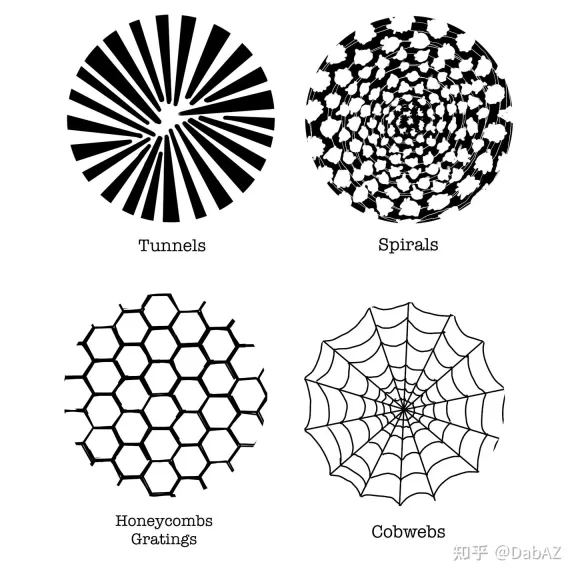
These patterns are read as omens of an inner world. We do not know their exact cause, but we know they originate in the visual cortex — one of the theoretical roots of dreaming. Under neuroplasticity, if the visual cortex goes unused for a long time, as in blind people, neighbouring regions invade it and reassign its function. Dreaming may therefore be a defence mechanism that keeps the visual cortex active during sleep, protecting its territory. [10]
That mechanism may explain the origin of dreaming, but not why dream content is so complex, or why so many other brain regions take part. The geometric patterns are still the first threshold. Some people remember them vividly; others have no memory of them at all. Only past that threshold does the real journey begin.
Layer two
In the second layer you enter a dream-like state. You are somewhere; you may already be someone; but the dream has not fully formed. The focus is a strange landscape — familiar but incomplete, open but missing detail. This surreal mood, often built from familiar places, bright colour, or distorted proportions, makes up the typical imagery of a dream.
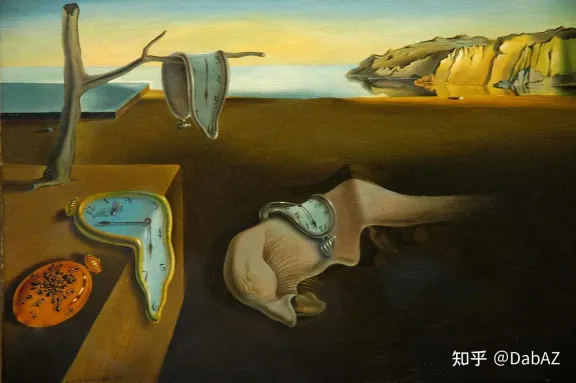
What stands out most is not the familiar objects but the presence of absence — the idea of negative space in art. Negative space makes the subject stand out through what is missing, guides the eye, and balances the composition. Too little and the image overwhelms; too much and it feels desolate.
In a dream, negative space appears as a vast emptiness, a place for emotional projection. Dream researchers describe it as “the emptiness behind perception”; Antti Revonsuo calls it “selective simulation” [11], and dream dictionaries call it an archetypal symbol of the void. At this stage the brain begins to build structure from the most vivid, most alive, most reachable material — memory — but not ordinary memory. It uses emotionally loaded neural activity, mostly from the amygdala rather than the hippocampus’s narrative memory. [12] So the dream that should take shape first appears as an unrealised emptiness, and that void forces the brain to project emotion into it. The result is a simplified, almost unrendered emotional landscape: pure feeling, in its rawest, most chaotic form, rising from the deepest memory, with no plot, no structure, and no characters yet. It is only the base for the layers above. What you experience is just the beginning.
Layer three
The third layer can be summed up by the airport dream. Many people report rushing to an airport, only to see the gate move or vanish as they approach; they change course and get lost. They plead for help and are ignored; some find the airport completely empty except for themselves. However hard they try, they miss the flight. One such dream is not so frightening, but when the same story repeats on a cruise ship, in a hotel, or at a resort, the fear grows. [13][14] The “never catching the transport” motif is usually read as anxiety about unfinished life tasks, with the specific setting supplied by whatever mode of transport you know best.
The key to this layer is metaphor. When a raw emotion takes centre stage, the brain has to give it a shape — turn up the volume, amplify it until it can be processed. Without language, it distils the emotion into one of five core themes: identity, desire, fear, loss, and conflict. [15] Then it reuses the memory fragments from before, reassembling them into a structure that can carry that theme. That is why dream plots are often illogical: they follow emotional logic, and causality serves the core feeling rather than literal sense. Why these five themes exist, and where they come from, is still unresolved — but clues are surfacing.
Layer four
The fourth layer is where boundaries are crossed: the dream no longer feels like it is coming from you; it feels like it is being generated for you. You meet recurring characters, places you will later visit for real, or seemingly independent agents — and above all you feel strongly that this belongs to me. One report describes a dreamer meeting the same figure night after night for more than a decade, knowing them since childhood and growing up together [4]. Another draws a city never visited — its colours, buildings, shop signs — and later finds the place exists exactly as dreamt [16]. A broader shared theme is being chased [13]: the pursuer may be a stranger or someone familiar, on foot or in a car, and it comes with the feeling that escape is impossible — legs heavy, falling again and again, finally caught. [17] It is never what the dreamer wants. They fight to survive, and it is always in vain.
We know that, in a sense, the fourth layer is where the brain extracts meaning from emotions it has already structured. Meaning is generated on two levels. The upper level is subjective and individual, shaped by your experience, memory, and how you interpret them. The deeper level is universal and instinctive, an innate neural template carved by evolutionary pressure. Generally the structure of a dream comes from the upper level, while emotional gravity — the five themes above — comes from the deeper, shared level. In your dream, the two run in parallel. To achieve that, the brain may rely on so-called emergent attractor networks: recurring memory themes produced by the pattern of neural connections, stable enough to be retrieved again and again, plastic enough to absorb new experience. [18] Plasticity gives you what feels controllable in a dream; stability corresponds to what you cannot control.
In a chased nightmare, then, the pursuer may map onto a real conflict figure from your recent life, while the experience of being chased carries the universal fear of conflict and its inevitable consequences. If a stranger keeps appearing, he may be a symbol of the stable layer you need to integrate; only when integration is complete does the loop of person and emotion fade. [19] In other words, it is precisely the uncontrollable stable part that gives a dream a consistent frame in which meaning can be read, while the plastic part is shaped and coloured by your life.
It should be said that research on the fourth layer is still full of gaps, and much of the above is inference from limited information. And stranger still: this is not the deepest point. In some dreams you realise I am dreaming, and that self-awareness opens another door entirely.
Layer five
The fifth layer is rare. It corresponds to the lucid dream: you are dreaming and you know it. If everything obeyed you, it would be wonderful — fly at will, walk through walls, play with the contents of the unconscious. But when you cannot control it, it becomes terrifying.
Two experiences are most common. The first is encountering hostile characters. [20] Some people tell a dream character “you are not real”; ideally the character does not react [7]; at worst it becomes angry, even snarls “you are not supposed to know”, and turns on the dreamer. We do not know why. What we do know is that parts of the prefrontal cortex are reactivated during lucid dreams. [21]
The second is the nesting dream, also called the false-awakening loop. You wake, start the day, dress, use the bathroom, brush your teeth. Everything is normal — until you look in the mirror and something is wrong. Your nose is on your forehead, or the colours in the mirror are off. The moment you notice, bang, you wake: “thank goodness, just a dream.” You relax and start the morning again. You look in the mirror; your face is still distorted, only this time the mirror’s colours are correct. Panic, bang, wake again. The third time you go straight to the bathroom on guard; the reflection is normal at last. You begin to relax, look once more, it distorts, bang, wake again. This time it is real. [22][23] Reports describe loops of up to seven awakenings, each closer to reality. The thought is chilling.
Some say this comes from a repeated tug of conscious tension inside the dream system. Others say your consciousness is out of sync with the sensory input of waking, so the system keeps checking the dream layer against the wake signal until the two match and you truly wake. [21] Either way, as far as we understand it, this is the final layer of the dream. It may raise more questions than it answers. Perhaps time will supply more clues.
References
- Hansen, H. B., Damgaard, P. B., Margaryan, A., Stenderup, J., Lynnerup, N., Willerslev, E., & Allentoft, M. E. (2017). Comparing ancient DNA preservation in petrous bone and tooth cementum. PLOS ONE, 12(1), e0170940. doi
- Hobson, J. A., & McCarley, R. W. (1977). The brain as a dream state generator: An activation-synthesis hypothesis of the dream process. The American Journal of Psychiatry, 134(12), 1335–1348. doi
- Okai, T., Kozuma, S., Shinozuka, N., Kuwabara, Y., & Mizuno, M. (1992). A study on the development of sleep-wakefulness cycle in the human fetus. Early Human Development, 29(1–3), 391–396. doi
- u/cottagecoredracula. (2025). I’ve been seeing the same person in my dreams for years [Online forum post]. Reddit. Link
- Dream series available for searching. (n.d.). DreamBank. Link
- Sleep and Dream Database. (n.d.). Link
- u/TheHentaiEnthusiast. (2019, June 1). I asked dream characters whether they were actual people [Online forum post]. Reddit. Link
- Bressloff, P. C., Cowan, J. D., Golubitsky, M., Thomas, P. J., & Wiener, M. C. (2002). What geometric visual hallucinations tell us about the visual cortex. Neural Computation, 14(3), 473–491. doi
- Kometer, M., & Vollenweider, F. X. (2016). Serotonergic hallucinogen-induced visual perceptual alterations. In Behavioral Neurobiology of Psychedelic Drugs (Current Topics in Behavioral Neurosciences, Vol. 36). Springer. doi
- Eagleman, D. M., & Vaughn, D. A. (2021). The defensive activation theory: REM sleep as a mechanism to prevent takeover of the visual cortex. Frontiers in Neuroscience, 15, 632853. doi
- Revonsuo, A. (2000). The reinterpretation of dreams: An evolutionary hypothesis of the function of dreaming. Behavioral and Brain Sciences, 23(6), 877–901. doi
- Miskowiak, K. W., & Harmer, C. J. (2012). The role of the amygdala in emotional memory. Frontiers in Neuroscience, 6, 1–6. doi
- Hyde, M. (2023). What are the most common nightmares? Amerisleep. Link
- DreamWell. (n.d.). What do airport dreams mean? Link
- Schredl, M., Germann, L., & Rauthmann, J. (2022). Recurrent dream themes: Frequency, emotional tone, and associated factors. Dreaming, 32(3), 235–248. doi
- u/fakenine_. (2024). I dreamed of a place I’ve never been to, but it actually exists [Online forum post]. Reddit. Link
- Sleep and Dream Database. (n.d.). Search results for “chased”. Link
- Spisak, T., & Friston, K. (2025). Self-orthogonalizing attractor neural networks emerging from the free energy principle. arXiv. doi
- Schredl, M., Germann, L., & Rauthmann, J. (2022). Recurrent dream themes: Frequency, emotional tone, and associated factors. Dreaming, 32(3), 235–248. doi
- Stumbrys, T., & Erlacher, D. (2017). Inner ghosts: Encounters with threatening dream characters in lucid dreams. Dreaming, 27(1), 40–48. doi
- Dresler, M., Eibl, L., Fischer, C., Wehrle, R., Spoormaker, V. I., Steiger, A., Czisch, M., & Pawlowski, M. (2014). Volitional components of consciousness vary across wakefulness, dreaming and lucid dreaming. Frontiers in Psychology, 4, 987. doi
- u/ninjaroot. (2025). Wake up in my bed but I’m still dreaming (DREAM LOOP) [Online forum post]. Reddit. Link
- [deleted]. (2025). I was stuck in a dream loop for 4 hours and kept waking up in a fake version of my bed. Has anyone else experienced this? [Online forum post]. Reddit. Link